


Wisconsin News
Wisconsin school districts put cellphone bans to the test
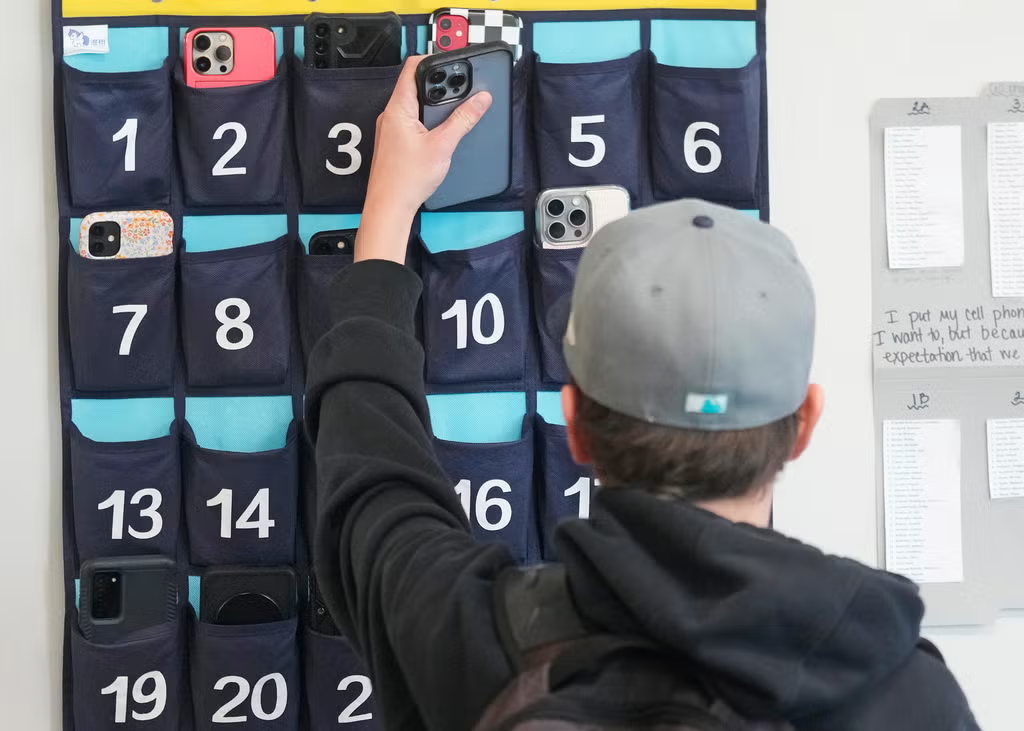
There’s some new lingo at Middleton High School: Get caught using your phone during class and you might get “green-slipped.”
“It’s kind of a running joke among students and staff,” Principal Bobbie Reinhart told WPR’s “Wisconsin Today.”
“The green slip is not meant to be a punitive action,” he continued. “It’s meant to be a reminder that, ‘Hey, in this building during learning time, we don’t use cellphones.’”
Wisconsin recently became the 36th state to enact a law limiting cellphone use in K-12 schools. The measure passed with bipartisan support. When Gov. Tony Evers signed the bill, known as Act 42, he said that cellphones can be “a major distraction from learning, a source of bullying and a barrier to our kids’ important work of just being a kid.”
The new law requires school districts to have policies in place to limit student use of cellphones during instructional time by July 1. The Middleton-Cross Plains Area School District, where Reinhart works, was an early adopter. The district has had a policy in place since the start of the 2024 academic year.
“I think we got out in front of it because we were really seeing the impact on students’ mental health that cellphones were having,” Reinhart said.
And it seems to be working. Just one semester after the policy was implemented, teachers in the district reported that their students were more focused and seemed happier. Greg Rodgers, a social sciences teacher at Middleton High School, said that the new policy “completely changed the culture of my classroom.”
“You walk into a classroom — it could be a gymnasium for a phys-ed class, it could be a math classroom or an English classroom — and the levels of engagement that we’re seeing are significantly increased,” Reinhart said.
These positive social results are consistent with the findings of a national study looking at the effects of school phone bans, published earlier this week by the National Bureau of Economic Research. Researchers looked at attendance rates, test scores, teacher and student surveys and other data from more than 40,000 schools between 2019 and 2026.
Schools that required students to place their phones in a lockable pouch for the day saw a significant decrease in nonacademic cellphone use among students, dropping from 61 percent to 13 percent, according to the study.
“We also found that teachers in schools that adopted the pouches were generally satisfied and happier than they were prior to pouches,” Brian Jacob, a public policy professor at the University of Michigan and one of the report authors, told “Wisconsin Today.”
Student well-being also went up as phone use decreased, with teachers and staff noticing more chatter and smiles throughout the school day.
While some educators thought that phone bans would lead to better academic performance, schools with strict phone policies did not see increased attendance or higher test scores, which Jacob acknowledged could be “disappointing to some.”
Schools with phone bans also saw a 16 percent uptick in suspensions, though the researchers note that this effect begins to “fade” after the first year.
Concerns around student disciplinary issues are the center of Madison Metropolitan School District’s ongoing deliberations as they move to establish a phone policy ahead of the state’s July 1 deadline. MMSD is the only one of Wisconsin’s 10 largest school districts that does not have an official policy in place yet.
“I like to say we haven’t had a policy with a capital ‘P,’” Deputy Superintendent TJ McCray told “Wisconsin Today,” noting that most schools in the district have had their own informal phone policies in place for the past few years.
“What we’re moving to now is really that capital-‘P’ policy,” he continued. “Our board is implementing and codifying a lot of the work that we’ve already been doing and the things that we need to do in response to Act 42.”
As part of that, the district commissioned graduate students at the University of Wisconsin-Madison’s La Follette School of Public Policy to study the issue and offer recommendations with an eye to equitable enforcement. The result is a 71-page report that includes student and staff surveys, data from other districts and a breakdown of the policy options, ranging from storing phones only during class time to “bell-to-bell” bans prohibiting phones all day.
“Taking the device out of the reach of students is actually the most equitable policy,” Connor Smith, one of the graduate students behind the report, told WPR. “This is backed up by our research.”
“It kind of puts everyone on the same playing field to begin with, and it lessens chances for those implicit biases to show themselves or … other kinds of enforcement inequities to come up,” he added.
As more schools roll out phone bans or adapt current policies, there’s going to be a “learning curve,” said Jacob, the University of Michigan researcher.
“There’s lots of activity on schools trying to figure out the best way to restrict student cellphone use, and what that means for other school rules, for curriculum, for pedagogy,” he said. “Schools will hopefully get better in figuring out ways to effectively restrict student phone use, and then, as importantly, figure out how to make use of students’ hopefully newfound attention going forward.”
Wisconsin Public Radio, © Copyright 2026, Board of Regents of the University of Wisconsin System and Wisconsin Educational Communications Board.