


Wisconsin News
A northern Wisconsin college spent down its endowment before it closed. Some donors think it broke the law
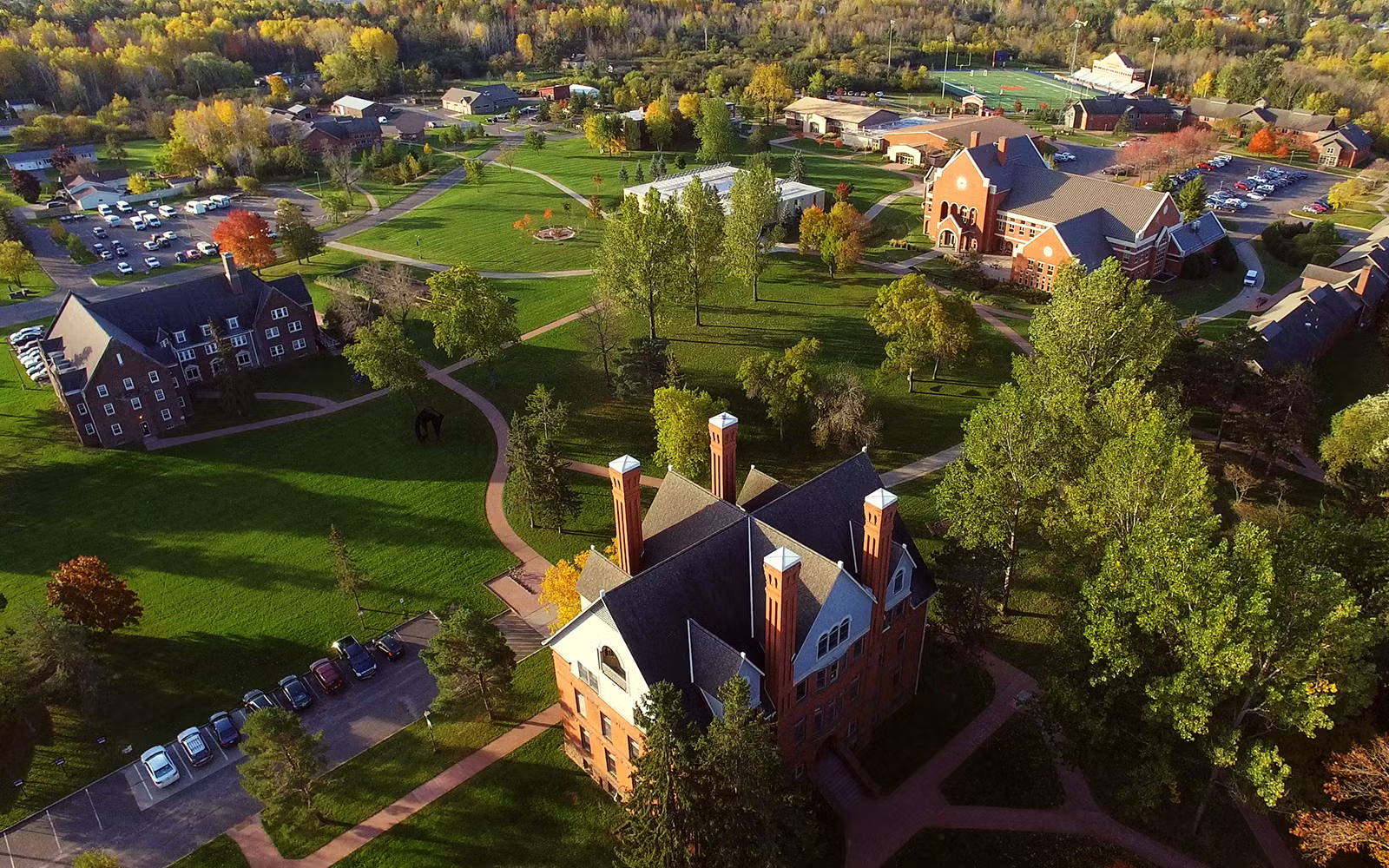
While attending Northland College in Ashland, Bjorn Norgaard volunteered for a local nonprofit group, shoveling snow and mowing lawns for seniors.
In 2011, a teenage driver killed the 23-year-old in a hit-and-run crash while he was skiing at night across a Lake Superior bay.
Bjorn’s father, Brett Norgaard, later heard from the family of an elderly couple his son had spent time with.
“They would make him dinner,” recalled Brett Norgaard, who lives in Northfield, Minnesota. “The husband had had a stroke, and he was not able to speak. But he was alert, and Bjorn would sit down with him and talk about hunting and stuff.”
With family and friends, Norgaard created a scholarship at Northland in his son’s name. Two years later, they set up the Brother Bear Endowment Fund to provide financial support to Northland students for various activities.
“What we wanted to do was to honor Bjorn’s adventurous spirit by providing funds, so that kids could honor theirs,” Norgaard said.
Over the years, Norgaard said family and friends donated at least $156,000 between the two endowed funds. But now, most of that money is gone.
The closure of the small liberal arts college in 2025 came after years of enrollment declines and financial struggles. Its aftermath has devolved into a legal battle between college officials and donors like Norgaard.
Earlier this year, the Northland College Board of Trustees revealed it had borrowed $22 million from its restricted endowment fund to fund operations and cash flow shortages. Now, only $3.3 million of the donor-restricted funds remain.
In February, the college filed a petition in Ashland County Circuit Court to release restrictions on those funds and approve its plan for distributing the remaining money to various nonprofit groups, institutions and foundations.
Last week, a judge appointed to the case found the board complied with state law and approved a modified version of the college’s proposal, which has not yet been signed.
But Brett Norgaard thinks the college violated a law that governs how institutions manage and invest endowment funds, and he wants the attorney general’s office to take another look at the college’s figures.
Wisconsin law requires institutions to honor donor restrictions on spending those funds, as well as manage and invest them in good faith.
Norgaard argues the college didn’t do that. He said he never gave the college written consent to change restrictions on spending his endowed funds. Despite repeated written requests, he said Northland has never provided a full accounting of how funds were spent.
“We threw everything into these two scholarships in terms of keeping (Bjorn’s) memory alive, and so it’s like a gut punch,” Norgaard said. “You feel like his legacy is somehow diminished. Money was set up, and now it’s gone.”
In a statement, Ted Bristol, chair of Northland’s board, said the college petitioned the court to distribute its remaining endowment funds in a “reasonable, fair and thoughtful manner that most closely aligns with donor intent.”
“Our petition outlines the process and reasons which led to the board’s difficult decision to close Northland College, despite our best efforts,” Bristol wrote. “We have tried to balance the interests of everyone involved affected by Northland’s closure.”
About one year before the college closed, Northland’s financial statements show the value of its endowment assets was close to $5 million — roughly $25 million less than the original restricted funds that were required to be maintained in perpetuity by donors.
During a May 8 hearing, Northland’s attorney Courtney Schultz with the law firm Saul Ewing said Wisconsin’s Uniform Prudent Management of Institutional Funds Act, or UPMIFA, allows a college to pool endowment funds for investment.
“It permits various types of investments by the college and one of those permitted types of investments is the type of inter-fund loaning that the college undertook,” Schultz said.
From 2012 to 2019, Schultz said the college loaned itself money from restricted endowment funds at various points after conducting the required analysis to ensure it was an appropriate investment under the law. In 2012, the college also obtained a court order that eliminated restrictions on funds with insufficient records, and more than two dozen donors authorized use of their restricted funds to repay debts.
Ben Orzeske is chief legal counsel for the Uniform Law Commission, which recommended updates to UPMIFA that were adopted in 2006. The law doesn’t expressly say an institution can’t loan itself money, but he said such a move is fraught with problems.
“It’s hard to say that 100 percent of the time it wouldn’t be allowed, but it would be difficult to structure a type of loan to an institution that would be deemed prudent under the law,” Orzeske said.
Susan Gary, professor emerita at the University of Oregon School of Law, drafted a committee’s revisions to UPMIFA. In this case, Gary said it was the fiduciary duty of the board of trustees to determine whether loaning the college money from its endowment funds was a prudent investment.
“The question would go back to: Was that decision a violation? Was it not, in fact, prudent? If there’s a challenge to that, the challenge would come from the attorney general,” Gary said.
Gary said oversight is often limited, and the time for review would’ve been when Northland began borrowing funds in 2012. But the law doesn’t require institutions to notify the attorney general of investments, and attorneys general have limited resources to investigate or track whether charities and institutions are following the law.
The Wisconsin Department of Justice declined to comment on the case. During a May 8 hearing, Assistant Attorney General Michael Morris told the court he reviewed documents provided by the college and determined there were no clear violations under the law. The office took no position on whether to grant or deny Northland’s petition.
“We acknowledge the unfortunate circumstance we find ourselves in with (a) $19 million shortfall in these endowments. Not only that but with other creditors of the college not getting paid — employees, professors, custodians and the like,” Morris said. “That’s why we decided to take no position both from a practical standpoint and from a no clear violation standpoint.”
Under the law, only the attorney general has the right to be heard on an institution’s request to release restrictions on endowment funds. During a July 9 hearing, Iron County Circuit Court Judge Anthony Stella said the court is not in a position to go back and account for every dollar that was spent.
“I have to rely on the college and the attorney general to have provided fair numbers here, absent some showing that there was something unlawful done,” Stella said.
Yet some donors disputed the accuracy of the college’s figures and its proposed distribution of remaining funds.
Attorney Erin Deeley with Stafford Rosenbaum, who represented the Mead Witter Foundation, raised concerns about inconsistencies in Northland’s financial reporting to the philanthropic group and the amount the college borrowed from its endowment.
At the July 9 hearing, Deeley said the foundation received regular updates through June 2023 that its $1.4 million endowment was intact. The foundation is slated to receive nearly $225,000 for its alternative beneficiary Carroll University in Waukesha. Northland’s attorney said financial reports provided by the college’s advancement office may have been different from what was actually on the books for its pooled endowment fund.
However, Deeley added that Northland’s financial statements through June 2023 show it borrowed around $7 million from its endowment between 2015 and 2019. The college later reported it had loaned itself $22 million from the college’s endowment fund from Feb. 2015 through June 2024.
A 2024 auditor’s report by accounting firm Wipfli found the college didn’t have anyone trained in generally accepted accounting principles to prepare financial statements as of June 2023. It also found staff turnover didn’t allow for proper segregation of duties. The report warned the situation “decreases the likelihood that unauthorized or false transactions will be prevented” or “may lead to misstated financial statements.”
Representatives of the Mead Witter Foundation said in a statement that the organization is dismayed by the attorney general’s choice to take no position on Northland’s petition and the court’s approval of it. The foundation said irregularities in management of endowment funds “strongly suggest” the college was violating the law.
“The court’s ruling and attorney general’s inaction will have a chilling effect on donors’ contributions to scholarship endowments, meaning it is students seeking help in funding their college education who will suffer the most in the long run,” the foundation’s representatives said.
While the court largely approved Northland’s proposal, it also required the college to pay the full roughly $90,000 amount of the Becky Rom Wilderness Advocacy Scholarship. In 2023, Lindsey Lang and two other women set up the endowed fund at Northland to honor Rom for her efforts to protect the Boundary Waters Canoe Area Wilderness from mining.
In court filings, Lang said former Northland President Chad Dayton had assured Rom in a Sept. 3, 2024 email that the scholarship remained fully intact despite the college’s financial challenges. Less than six months later, the college announced its impending closure.
Lang said they made numerous requests in 2025 and this year to transfer the scholarship fund to Macalester College in Minnesota. In April, she learned Northland had reduced the amount of the fund to roughly $13,000 under the college’s proposal.
Lang persuaded the judge that the scholarship should be treated differently because the fund was created after the college borrowed money from restricted endowment funds. Overall, Lang said she’s satisfied the court found the Becky Rom scholarship should be made whole.
“That’s the relief we sought, and that’s the relief I think we’re getting,” Lang said.
However, the change will reduce funds allocated to nonprofit groups the Sigurd Olson Environmental Institute, or SOEI, and Burke Center for Ecosystem Research. Even so, Rocky Barker, treasurer on SOEI’s board, said he’s pleased the group is set to receive around $900,000. He said it will help further the legacy of writer and conservationist Sigurd Olson, who led efforts to preserve wilderness and the Boundary Waters.
“If we get this money, it’s a transition point from survival to sustainability,” Barker said. “It really makes a big difference for us.”
No endowment fund was more affected by the college’s borrowing than the $10 million set aside in 2015 for the Burke Center for Freshwater Innovation, said Jonathan Ingrisano, an attorney with Godfrey & Kahn representing the center. The Burke Center’s endowment was restricted for use on supporting freshwater research and policy.
In court filings, Ingrisano called the college’s repeated borrowing from the fund and other restricted endowments “regrettable.” The newly formed Burke Center is slated to receive nearly $2.1 million.
“Donors are right to be frustrated with how endowment funds were used at Northland College. … However, the attorney general is responsible for reviewing these matters and he has not challenged the college’s decision on how to allocate the remaining funds,” Ingrisano said in a statement.
After Northland closed, Norgaard and his family set up a new scholarship, the Bjorn Norgaard Adventurous Spirit Memorial Fund, at Northfield High School in Minnesota. Under the college’s proposal, almost $8,200 will be transferred to the nonprofit organization Northfield Shares to manage the fund.
He and other donors could recover additional funds from any sale of the college’s assets.
Wisconsin Public Radio, © Copyright 2026, Board of Regents of the University of Wisconsin System and Wisconsin Educational Communications Board.