


Wisconsin News
Bald eagle pair in Wisconsin raises rare set of quadruplets
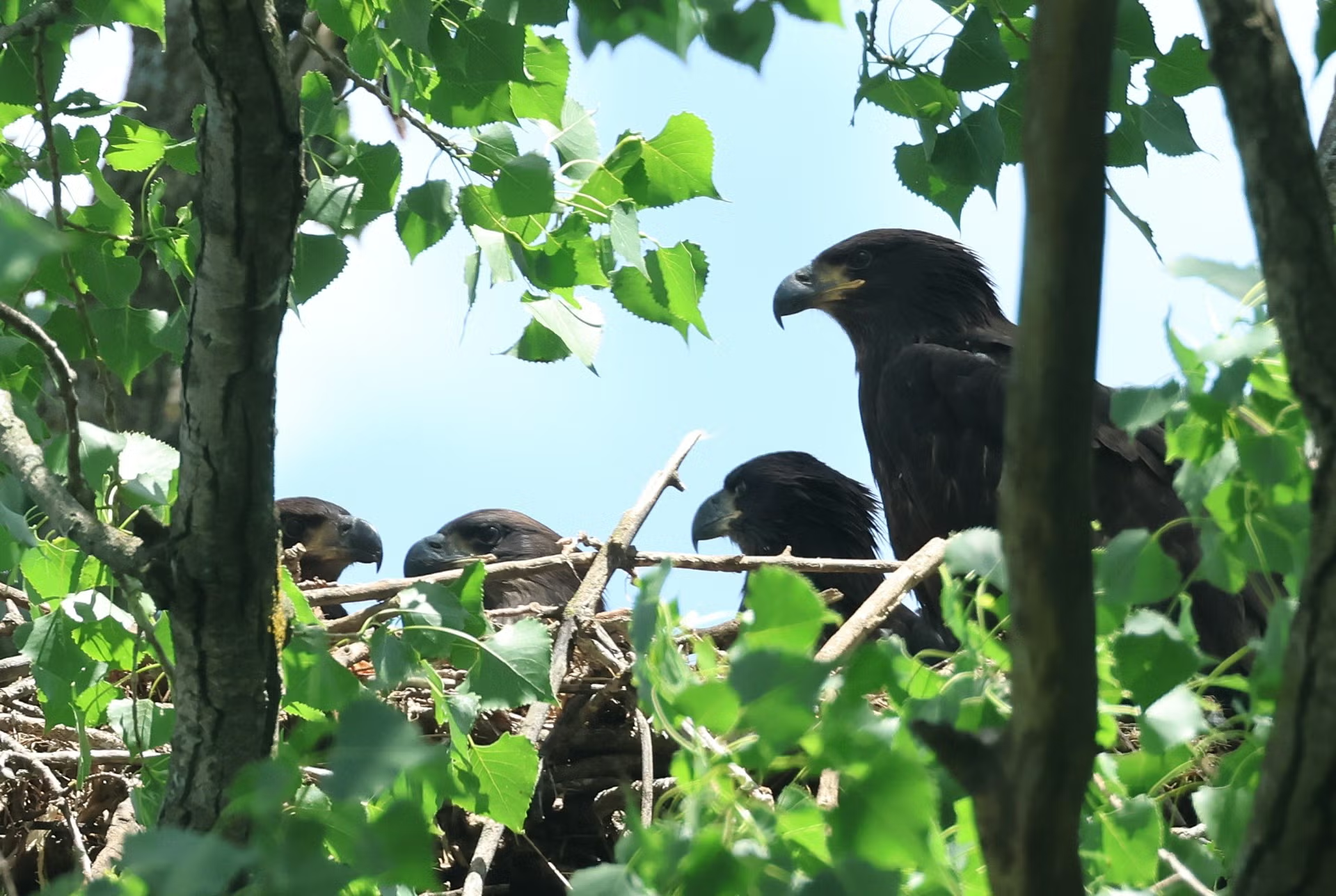
Photo courtesy of Beth and Ken Martin
The bald eagle has long been seen as a symbol of pride, strength and freedom for the United States. As the nation celebrates its 250th anniversary, one nest of the birds is attracting attention in Wisconsin for a rare sight: quadruplets.
In June, volunteers with the Southern Wisconsin Bird Alliance spotted a nest of four healthy eaglets in Dane County. Wade Mapes of Madison first caught sight of the four birds as he was monitoring a nest for the alliance’s Bald Eagle Nest Watch program.
Drew Cashman, who co-created the program in 2018, said he received an email from Mapes about the discovery.
“He sent a picture that he had taken of the three, and there were clearly three,” Cashman said. “Then there was one that was kind of hiding on the other side of the nest. It was not as visible. But after looking at it for quite a while, I said, ‘That definitely looks like a beak and a head.’”
Bald eagles do not develop their distinctive white heads until they are around 5 years old, so the quadruplets have dark feathers.
Most eagles also begin mating around 4 to 5 years of age, and pairs typically lay between one and three eggs. Around half produce two young. About 10 percent yield three. But a nest of four eaglets that are ready to fly happens only about 0.1 percent of the time nationwide, said Brenna Marsicek, director of outreach for the Southern Wisconsin Bird Alliance.
“This has only happened one other time since we began monitoring nests in Wisconsin, and that was in 2020 with a nest in the Fox Valley,” Marsicek said.
When first viewing the photo, Marsicek admits she was skeptical and in a state of disbelief. It was difficult to get a clear view of the nest as leaves from the Cottonwood tree blocked them from view. Volunteers observing nests must also stay around 300 feet away during the breeding season in line with federal regulations.
But as more photos rolled in, they left no doubt about the rare set of quadruplets.
“It’s an indicator that the environment around the nest is doing well, that we’re doing a good job of keeping that area clean and safe,” Marsicek said.
For Cashman, the four eaglets are a sign that conservation can happen in more urban areas.
“For them to raise four, there have to be enough prey items to keep them healthy and well-fed,” Cashman said. “So that’s a success story for us, as well, that these eaglets are healthy and they’re progressing.”
For many years, that wasn’t the case. In the mid-20th century, the bald eagle faced threat of extinction throughout most of its range due to habitat destruction, illegal shootings and contamination of fish they ate by the insecticide commonly known as DDT.
In 1940, Congress passed the Bald Eagle Protection Act to ban killing the birds. At one time, accounts stated the nation had as many as 100,000 nesting eagles, but by 1963 that had dropped to only 417 nesting pairs.
The dangers of DDT came to light due largely to Rachel Carson’s 1962 book “Silent Spring,” and the Environmental Protection Agency eventually banned the pesticide in 1972. A year later, the Endangered Species Act was passed.
In 1978, federal protections for the bald eagle were expanded throughout the lower 48 states except where the birds were listed as threatened in Michigan, Minnesota, Oregon, Washington and Wisconsin. In 2007, the bald eagle was removed from the endangered species list after its successful recovery.
In Wisconsin, the most recent survey in 2019 found 1,684 eagle nests. This year, the Southern Wisconsin Bird Alliance and partner organizations have more than 500 volunteers monitoring 343 nests across 44 counties. On average, Marsicek said 85 percent of nests produce healthy young.
For four years, Wade Mapes has been monitoring the Dane County nest, which showed no sign of any eaglets the first two years. Last year, he spotted two, and now four this year.
In recent days, Cashman said three of the four have fledged, meaning they’re able to fly away from the nest.
“Wade is still monitoring the nest until that fourth one fledges,” Cashman said. “What they do a lot of times is the adults will still feed the eaglets in the nest. They’ll still drop off food. We have gotten observations that they are coming back to the nest.”
Marsicek and Cashman expect they’ll stay in the area and use the nest as a base camp through the end of the summer until the four are ready to head out on their own and chart their own path.
Wisconsin Public Radio, © Copyright 2026, Board of Regents of the University of Wisconsin System and Wisconsin Educational Communications Board.