


Wisconsin News
The ‘Crowley comeback’ defied the odds, and reset expectations
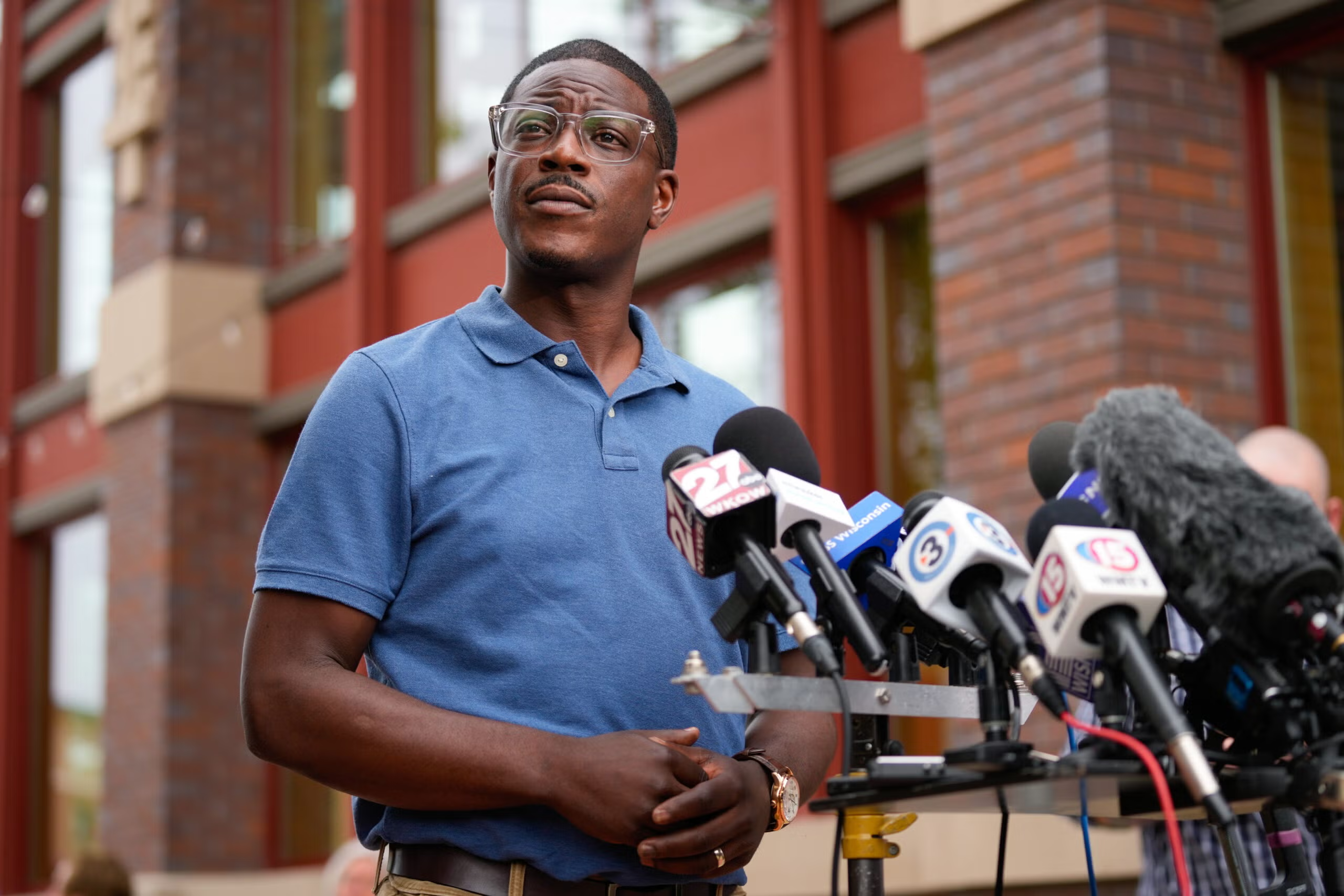
In a Wisconsin primary for governor that was as wild as they come, it’s only fitting that the person who won the Democratic nomination was considered a failed candidate just a month ago.
What David Crowley pulled off in the weeks since he got back in the race still seems borderline impossible. He went from a candidate without a clear political lane to the mainstream frontrunner — from practically invisible in polling to the winner of 50-plus counties, and more than 315,000 votes.
“I think 50, 60 years from now, it is not an exaggeration to say that there will be campaigns somewhere in America down by 20 points in the polls,” said Democratic consultant Joe Zepecki. “And some old hat in the office will call everybody together and say, ‘Kids, let me tell you about the Crowley comeback.’”
Crowley defeated Madison Rep. Francesca Hong by around 3,800 votes, according to preliminary totals. His win came after Hong led in nearly every poll — including one released last week by Crowley’s campaign.
It’s not that the surveys were entirely wrong. They consistently showed large numbers of voters who had yet to pick a candidate in the Democratic primary. It just so happened that most of them broke for Crowley in the end.
“For him to pick up pretty much all of the undecideds is frankly unprecedented,” said longtime Republican operative Bill McCoshen. “Democratic voters woke up in the final 10 days and realized what was on the line.”
That likely would not have happened without Gov. Tony Evers, who endorsed Crowley when he got back in the race on July 18. But the path to that endorsement was anything but straightforward.
Evers had previously remained neutral, even though four candidates — Sara Rodriguez, Mandela Barnes, Missy Hughes and Joel Brennan — had direct ties to the governor.
Then, Crowley dropped out. He endorsed Rodriguez. Days later, she fired her campaign manager, then she ran out of money. And then Rodriguez, who had been trending toward frontrunner status, dropped out herself.
Democrats had a choice at that point. They could back Hong, a democratic socialist with a penchant for controversial statements. Or they could support one of the remaining candidates.
Evers chose a far riskier option: He would back Crowley once he got back in.
When Marquette polled Democratic voters in March, just 3 percent supported Crowley. In late July, days after Evers’ endorsement, that number climbed to 7 percent. And on Tuesday, 35 percent of Democratic voters supported Crowley.
“When you have the most popular Democratic politician in the state for the last three weeks say ‘This is my guy, this is who I trust to run the state going forward,’ that can absolutely make a difference,” Zepecki said. “And I think in this case it did.”
Evers’ endorsement had a multiplying effect when the national spotlight shined on Wisconsin’s primary.
Hong’s candidacy was viewed as the next test of democratic socialism in the U.S., after progressive challengers had prevailed against establishment Democrats in other states, including in Michigan the week prior.
None of the other Democrats in Wisconsin’s primary really attacked Hong. Crowley did. That attracted national attention, and McCoshen said it may have expanded the pool of voters.
“That had a significant impact on the outcome,” McCoshen said. “I think that’s one of the reasons David Crowley was able to eke out a win. More people were paying attention.”
Compared to 2018, when Evers won a fractured primary for governor, roughly a quarter million more people cast ballots in this year’s Democratic race.
Part of Crowley’s case against Hong was that Republicans not only wanted her to be the nominee — they were spending money trying to make it happen.
A group tied to the Republican Governor’s Association spent $3.6 million on ads ostensibly attacking Hong, which many Democrats viewed as an effort to prop up her candidacy.
Whether the ad blitz helped or hurt Hong is debatable. McCoshen said meddling in primaries has worked for Democrats in other states, but it “clearly” didn’t work for Republicans here.
“They may have woken up some moderate Democrats who said, ‘Holy smokes, that’s not what I was looking for in a gubernatorial candidate,’” McCoshen said.
Then again, in a race decided by fewer than 4,000 votes, it’s hard to pinpoint any one thing that caused it to tip Crowley’s way.
There’s an argument to be made that Hong stumbled at the end. She spent the final days of the race explaining a social media post from 2020 where she said “Cancel Thanksgiving.” She visited the site of a police shooting in Madison and proclaimed it an “execution.” She campaigned with Hasan Piker, the controversial left-wing livestreamer.
And she made tactical decisions to not attack Crowley and to not run traditional television ads.
“I think it’s going to be questioned for the rest of political history as to why she didn’t do that,” McCoshen said.
Zepecki said it’s easy to second-guess those decisions now, but Hong’s approach is what made her a contender in the first place.
“In a margin this narrow, everything matters. If David Crowley had waited one more day to get back into the race … if Fran Hong had run six spots on basic cable … any of that can get you 5,000 votes,” Zepecki said. “But … I think the way she got there was by throwing out the old playbook.”
Crowley’s victory sets up a general election contest that few people anticipated.
He’ll face U.S. Rep. Tom Tiffany, a Republican from Minocqua, who had recently focused his attacks against Hong, and presented himself as an everyman alternative to the rise of socialism.
After Crowley’s primary win, the Center for Politics at the University of Virginia changed its rating for Wisconsin’s race for governor from “Toss-up” to “Leans Democratic.”
On the political betting markets Polymarket and Kalshi, Tiffany was previously favored to win in November. Those odds flipped overwhelmingly to Crowley overnight.
Much was made of how Hong’s politics had divided the party before the primary. But on Wednesday, she was very much a team player, holding an event with Crowley and telling her voters to support him.
In Tiffany, Democrats now get to run against a Trump-endorsed candidate. With Crowley, they can do it without as much political baggage.
“Tom Tiffany has a lot to answer for,” Zepecki said. “That’s not going to go well for him.”
McCoshen said Tiffany will focus on issues that favor him, like Evers’ 400-year veto that increased local property taxes.
So far in the race, Tiffany has enjoyed a huge fundraising advantage. If money keeps flowing on both sides, it could be another razor-thin Wisconsin election in November.
“The framing of the race really starts today,” McCoshen said.
Wisconsin Public Radio, © Copyright 2026, Board of Regents of the University of Wisconsin System and Wisconsin Educational Communications Board.