


Wisconsin News
Diver discovers 1,000-year-old dugout canoe in southeastern Wisconsin lake
Mark Schachtner loves finding old embossed glass bottles while diving in southeastern Wisconsin lakes.
The Beaver Dam man has been diving for about 10 years. He goes out every week with the Four Seasons Dive Club, finding beer and medicine bottles on lake beds.
But one day in early May, he discovered something much older, beating out his previous manmade finds by, well, centuries.
“I found a fossil once in one of the other lakes … but this is the oldest manmade thing I’ve ever found,” Schachtner said.
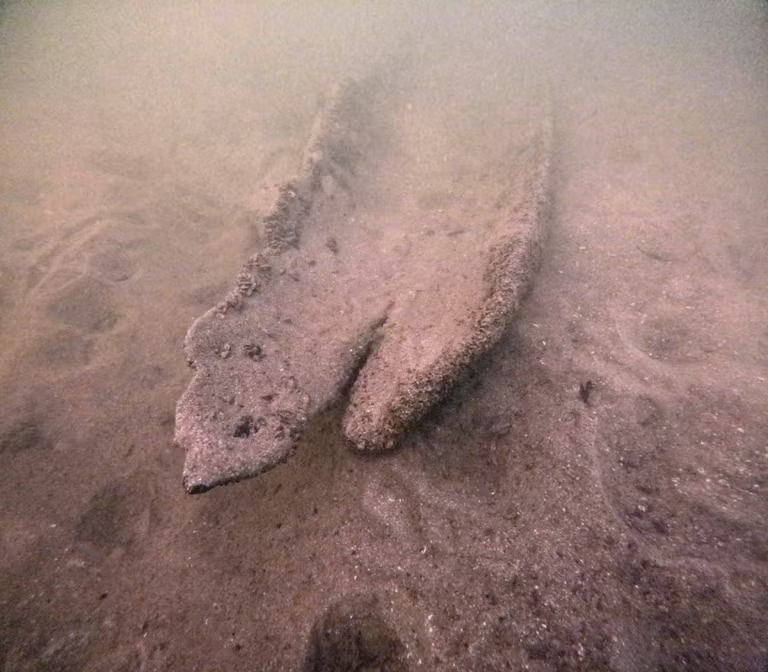
While diving in Pewaukee Lake, Schachtner glimpsed what he believed to be an ancient dugout canoe. Radiocarbon dating has since confirmed the 17-foot-long vessel is around 1,000 years old, according to the Wisconsin Historical Society.
Schachtner recognized the canoe from working with Tamara Thomsen, a maritime archeologist with the Wisconsin Historical Society. She’s discovered 16 canoes in Madison’s Lake Mendota.
Days after the find, Thomsen said she went out with Schachtner to collect measurements, video, images and wood samples. She called it a beautiful find. The canoe is intact and submerged on the lake bottom where it’s filled with sediment. Thomsen said that’s not due to shifts on the lake bed over time.
“It’s a classic look for a canoe that had been cached, something that had been intentionally sunk,” Thomsen said. “It was very common for the Indigenous people of the time to bury the canoes on the lake bed to fill them with sediment, and then to return a season later or two and dig them out and dry them out a little bit. Then, they would be functional.”
Michael Wiemann at the U.S. Department of Agriculture’s Forest Products Lab in Madison determined the canoe was made out of white oak similar to other canoes previously found in Lake Mendota. Miami-based lab Beta Analytic conducted radiocarbon dating that showed a 70 percent chance the canoe was in use between 992 to 1049 AD or about 1,000 years ago.
Much of what’s known about the time period has been pieced together by archeologists from objects found around the lake. Jon Greendeer, president of the Ho-Chunk Nation, told WPR the find falls within the nation’s territory. He said he was extremely excited about the discovery, but he said it’s not a surprise to find canoes or other artifacts in the area.
“What we were told, a lot of these were crafted from carving vessels from fire,” Greendeer said. “All I can say is it took a lot of time. … You can imagine how much work went into each one of these.”
Thomsen said they could see evidence of char marks on the bottom of the canoe and scraping likely from stone tools or shells to shape the vessel. Greendeer said the crafts may not have been used only for transportation, but also to carry materials that include netting and weights used to harvest fish.
“Our way of life really dictated you know the basic essentials: food, water, shelter,” Greendeer said. “Making sure that we were able to harvest the food to feed our village and families was a big part of that.”
The late 10th to early 11th century is known as the Late Woodland period and was associated with effigy mound building in Wisconsin, according to the Wisconsin Historical Society. At the time, Cahokian people established settlements that included Aztalan, now Aztalan State Park, along with trading posts.
Potawatomi towns and camps also lined the shore of Pewaukee Lake dating back to the 1840s. Indigenous people traded shells, furs and other goods with white merchants beginning around the early 1800s.
The Wisconsin Historical Society is consulting on the discovery with Larry Plucinski, tribal historic preservation officer for the Bad River Band of Lake Superior Chippewa, and Bill Quackenbush, retired tribal historic preservation officer for the Ho-Chunk Nation.
State archaeologists and volunteers have examined 88 out of 130 known vessels on lake bottoms and within collections across the state, said Thomsen. The maritime archeologist noted only Florida has more dugout canoes than Wisconsin with more than 400.
Even so, Thomsen said Wisconsin has half of the top 10 oldest canoes in eastern North America, including a 5,200-year-old canoe found in Lake Mendota that’s the oldest boat discovered in the Great Lakes region.
Florida is home to the oldest canoe in eastern North America, dating back around 7,000 years.
The discovery of the roughly 1,000-year-old canoe in Pewaukee Lake is actually the second ancient canoe found there. Thomsen said the first was discovered and removed in the 1930s, according to a search of newspaper accounts.
But the Wisconsin Historical Society doesn’t plan to recover the dugout canoe from the lake as Native Nations, including the Ho-Chunk Nation, have said they wish it to remain in place out of respect for their ancestors. Divers may not remove artifacts from the site, which is protected under Wisconsin law.
The vessel would disintegrate once exposed to air without similar intensive conservation measures being used for two canoes recovered from Lake Mendota.
Wisconsin Public Radio, © Copyright 2026, Board of Regents of the University of Wisconsin System and Wisconsin Educational Communications Board.