


Wisconsin News
How new TrumpRx program could affect Wisconsin pharmacies and patients
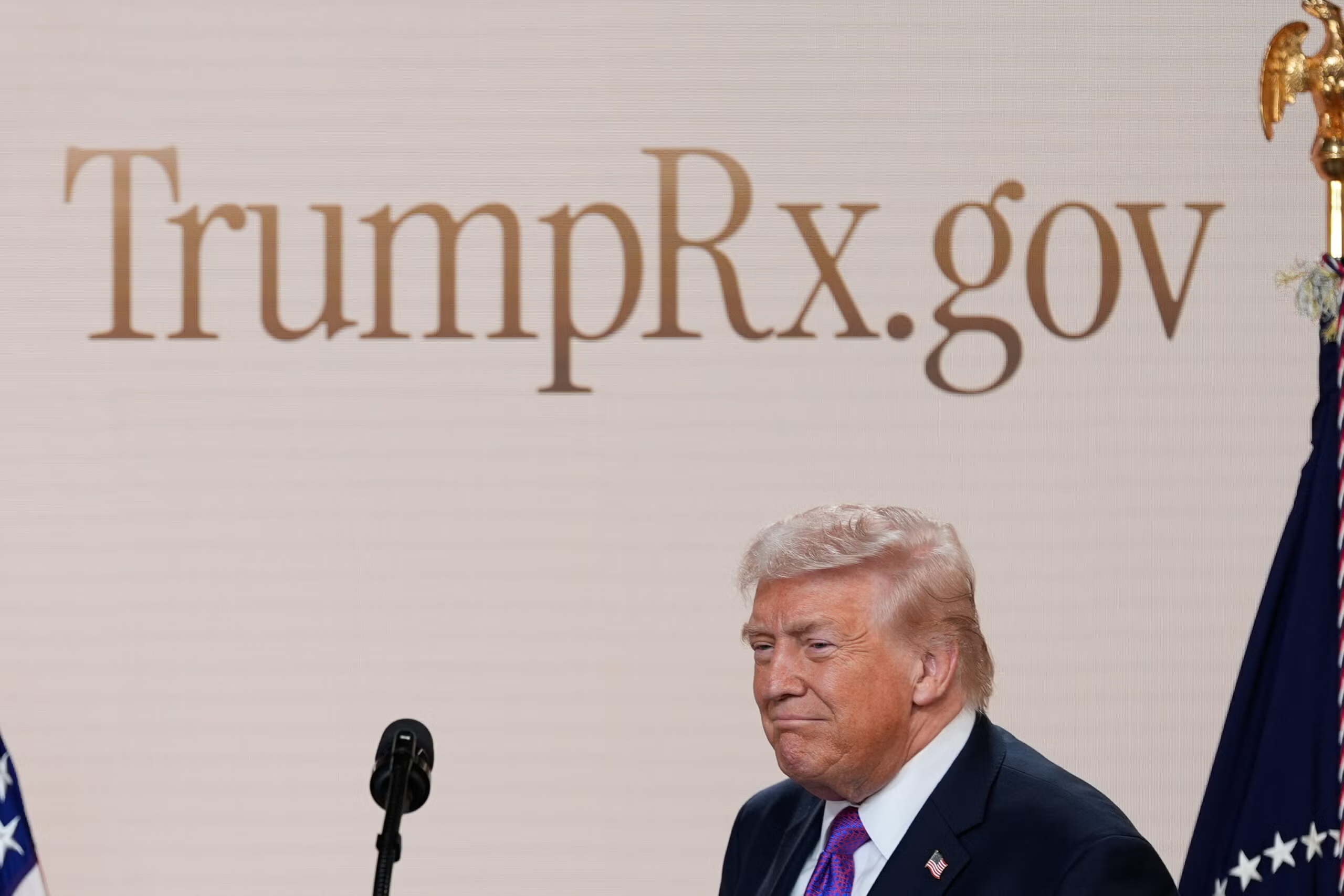
The Trump Administration recently launched its new TrumpRx online platform that helps connect people with direct-to-consumer prescription drugs at a discount.
It was part of a negotiated deal with pharmaceutical companies that was announced in the fall, promising to make prescription drugs more affordable for patients.
Wisconsin pharmacist Hashim Zaibak, CEO of Hayat Pharmacies, is skeptical.
“It sounded like a terrific idea, because definitely we do need to get the cost of medication better here in the United States,” Zaiback said. “But I think we’re still steps away from finding a true solution.”
He joined WPR’s “Wisconsin Today” to discuss how the new TrumpRx program works and what barriers patients face with prescription drugs.
The following was edited for clarity and brevity.
Kate Archer Kent: How much of an impact do you think a program like this can have?
Hashim Zaibak: It’s going to have very little impact right now. I looked at the 43 drugs that they have listed, and many of them are products that have been (available) in generic (form) for many years. I’ve been a pharmacist for 26 years and I don’t remember the last time I dispensed a brand name — Diflucan, for example. That’s a medication that is sometimes used for yeast infections.
It does sound good, because it’s reducing the price of the brand-name (drugs), but nobody’s using the brand-name. Everybody is getting the generic for $2, so it’s not as good as it sounds.
But I’m still optimistic. I think that if they continue to work on finding the right manufacturers who are willing to work with them, they’re going to find better solutions. But so far, I’m not very impressed.
KAK: Do pharmacies like yours have much negotiating power with drug companies? Or are you mostly forced to sell prescription drugs at the prices they provide you?
HZ: When it comes to the brand-name medications, we absolutely have no negotiating power. We have to go by what the wholesalers are telling us and it’s usually a standard price. So when it comes to a brand name like Ozempic, I’m going to have to buy it from my primary wholesaler and there is really no negotiation there. When it comes to the generic, yes, you can (negotiate). If you go from one wholesaler to another, the cost can be 50 percent or sometimes even 25 percent of others.
KAK: How well does insurance normally help to reduce the cost of drugs for patients? Is there potential for savings by not using insurance and paying cash through a platform like TrumpRx?
HZ: The challenge is with the brand-name medications that cost a lot of money. Especially now, more than 50 percent of the drugs that are being introduced in the market are specialty drugs that cost thousands of dollars and we don’t have a way right now to reduce that cost. The manufacturers are trying to get their research and development cost to make the drug, and then between us as pharmacists and the insurance or the payers, there is a middleman called the PBMs, pharmacy benefit managers.
In my opinion, they’re part of the problem, because they are collecting rebates from the manufacturer. They’re basically going to that to the manufacturer, like Pfizer, and they’re telling them, “If you want your drug to be on our formulary, you have to pay us a rebate.” That rebate can be up to 30 or 35 percent of the actual cost of the medication.
We as pharmacists don’t see that. The patient does not see that and then a lot of time the payers don’t see that. That goes straight to their pockets. So I think that as a country, we really need to find a solution for this. We are the only country in the world that has PBMs.
KAK: How often is cost a barrier for the patients you see at your pharmacy? Is it more about the cost of prescription drugs themselves or a lack of insurance?
HZ: We have a lot of uninsured patients and those are the ones that are most vulnerable, because those are the ones that have absolutely no coverage. For the people who do have insurance, whether it’s private or Medicaid or Medicare, there is a way for them to get the prescription that they need. If a drug is medically needed or medically necessary, there is a way, for example, to get the prior authorization and get it covered. There are programs to help with the copays.
The biggest challenge is the people who are uninsured. Most of the time, we’re able to take care of them with some of the products that are already available in a generic form. But sometimes, they do need some of those expensive medications that don’t have generics and they don’t have an alternative. Those are the ones that actually cost a lot of money, and a lot of times, unfortunately, they get stuck, either by paying a lot of money to get them or going without them.
KAK: We’ve seen a lot of upheaval around immigration enforcement and growing fears here in Wisconsin. Are you seeing that added stress make it more difficult for patients to go out and get the care they need and stay on their medicine regimens?
HZ: We’ve actually seen an increase in the number of people who want home delivery in the last few months, and I’m assuming some of these people are scared of leaving their homes, so they are requesting the delivery more often, even though they have cars.
We have few patients who are not coming to the pharmacy anymore, and we were told from other people that the reason is because of what’s going on right now with ICE activity.
KAK: Are there other initiatives you liked to see from government leaders or other stakeholders to address prescription drug costs and access?
HZ: I’d like to see all the stakeholders come together and find the solution. Because if the manufacturers alone are trying to resolve this issue, they’re not going to find a solution. If the pharmacies and the pharmacists alone are trying to work on this, they’re not going to find a solution. The doctors, the PBMs — I think we all need to sit down together and see what we can do.
Being the richest country in the world, what can we do to make our medications more affordable? Not by having a website that says we are the world’s cheapest medication. Yes, these are all nice things to have on the website. Of course that sounds very good, but I want some real solutions, not a solution that already existed before TrumpRx. For example, the manufacturer coupons for some of those drugs existed before TrumpRx. So just to say that we invented something new when it’s really not new, that’s not going to help.
Wisconsin Public Radio, © Copyright 2026, Board of Regents of the University of Wisconsin System and Wisconsin Educational Communications Board.