


Wisconsin News
Madison police chief wants officers to think critically about use of force
By Joe Tarr
Madison Police Chief John Patterson says his city is long overdue for adopting police body cameras.
“It’s such a relief, I have to say, to finally be moving towards this technology,” Patterson told WPR’s “Wisconsin Today.” “And frankly, it’s a technology that almost the entire rest of the state has deployed within their communities.”
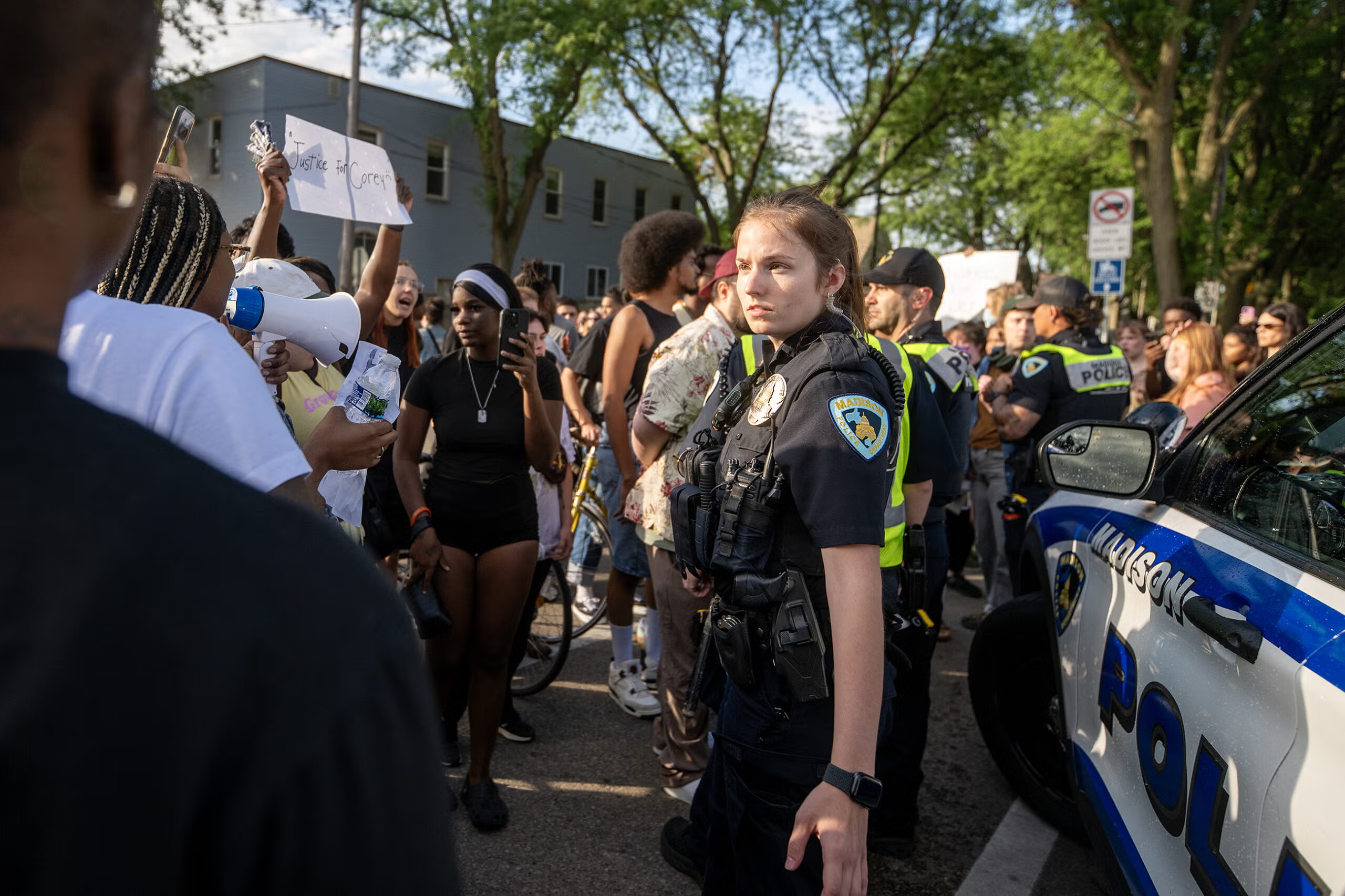
For more than a decade, the city has been divided over whether or not to equip its officers with cameras, with some community activists worried about how the footage might be used. But after a Madison police officer fatally shot Corey Ruiz on July 22, a new call for cameras emerged. At the end of September, the city announced that thanks to a grant from the Madison Community Foundation, all officers will have them by the end of 2027.
The police department is also promising to better scrutinize how officers are using force with the creation of the Service Excellence and Outreach Section.
Patterson told WPR’s “Wisconsin Today” that the effort to better evaluate officers’ performance isn’t directly a result of the Ruiz killing.
“We need to be more proactive in the law enforcement field and not just acknowledge the data that’s at our fingertips, but use it in a way that will be more responsive to our community and improve as we can,” he said.
Patterson spoke to “Wisconsin Today” about the changes in the works for the department.
The following has been edited for clarity and brevity.
Kate Archer Kent: How do you envision this Service Excellence and Outreach Section operating?
John Patterson: Nothing can impact negatively the trust that you have in your community more than any instance, frankly, of use of force. Right now, I could tell you how many instances of use of force have occurred in the downtown district, for example, in Madison this last month. I don’t have at my fingertips all of the decision points that went into every specific instance where force was used. We need to dedicate resources that will allow us to dissect each incident and, in a proactive and professional development way, walk our staff through each of their decision points, get them to think critically, and really embrace the core value that we have of continuous improvement, and try to see if there aren’t better ways to approach the same situations.
KAK: How did the Madison Police Department evaluate its officers when they used deadly force, and then what will change?
JP: We fortunately don’t have frequent occurrences of the use of deadly force, but we do look at all use of force on a biweekly basis. I’m provided summaries of each specific incident, and then each month, I’m given a further breakdown of where they’re occurring within our workforce, what trends we’re seeing in our workforce demographics, and then across districts as well. That’s an opportunity to bring the community closer to the table and have those same discussions with us, help us look at instances in their entirety, but also what commonalities are we seeing, or what stark differences we may be seeing from one district to another, for example, or from one shift to another.
KAK: What are some benchmarks for progress? What are you aiming toward?
JP: Right now we can very easily tell which officers are using force more than others. That’s not saying that they’re necessarily doing anything wrong, but we should look at all the other factors at our fingertips as well, like the types of calls that they may be disproportionately responding to than others, what differences might exist in the district that they’re serving? What differences might exist within their shift, and if there are other supportive measures like training that we can offer, that’s what we’re hoping to achieve. … We should never just look at a specific outcome and walk away from it, even if it was a good outcome. There are always things that we can learn from, do differently, and improve upon.
KAK: The department’s use of force policy says that officers are obligated to intervene when they witness another officer using excessive force. How challenging is it for an officer to rein in a fellow officer?
JP: In some environments, it could be very challenging. What we try to do is foster an environment where psychological safety exists. Any police officer, any employee, should feel very comfortable making mistakes, and understanding that they can learn from them. They also must be very comfortable asking questions of their supervisors, asking questions when decisions are made, and not live in a work environment where they’re living in fear of admonishment or retribution. So really, from the minute they enter our doors, we try to foster this concept of psychological safety because if I don’t feel comfortable working in an environment where I might be able to learn from a mistake or ask questions of a supervisor without retribution, how could I possibly be expected to then intervene when I’m seeing something wrong? Trying to create that culture of learning and fostering that psychological safety is critically important in this profession.
KAK: But time in those moments is also very critical. So, you know, quoting from the policy, an officer observing the use of excessive force shall notify an uninvolved supervisor as soon as practicable. But what if it’s too late? What if the permanent harm has been done?
JP: That’s a fantastic question and that’s part of what we’re also hoping to really get us thinking critically about. Twenty-five years ago, when I was a new officer, I had just joined the SWAT team. We were evaluated on how quickly we could execute a search warrant. For example, I remember my supervisor literally with a stopwatch, ensuring that we could get through a door and into our area within seven to 10 seconds. And now our SWAT team has gone completely on the other end of the spectrum, and they’re going out of their way to maximize time and space so that decisions are not becoming compressed, and so that options are not limited. That’s something that we really have to focus on, breaking down our decisions in all of the different points. … Hopefully maximizing that time and space will create even greater opportunity, not just for de-escalation, but for intervention if that’s what needs to occur.
Wisconsin Public Radio, © Copyright 2026, Board of Regents of the University of Wisconsin System and Wisconsin Educational Communications Board.