


Wisconsin News
The Draconid meteor shower, a celestial event that respects bedtimes, will peak Oct. 8
By Elissa Eaton
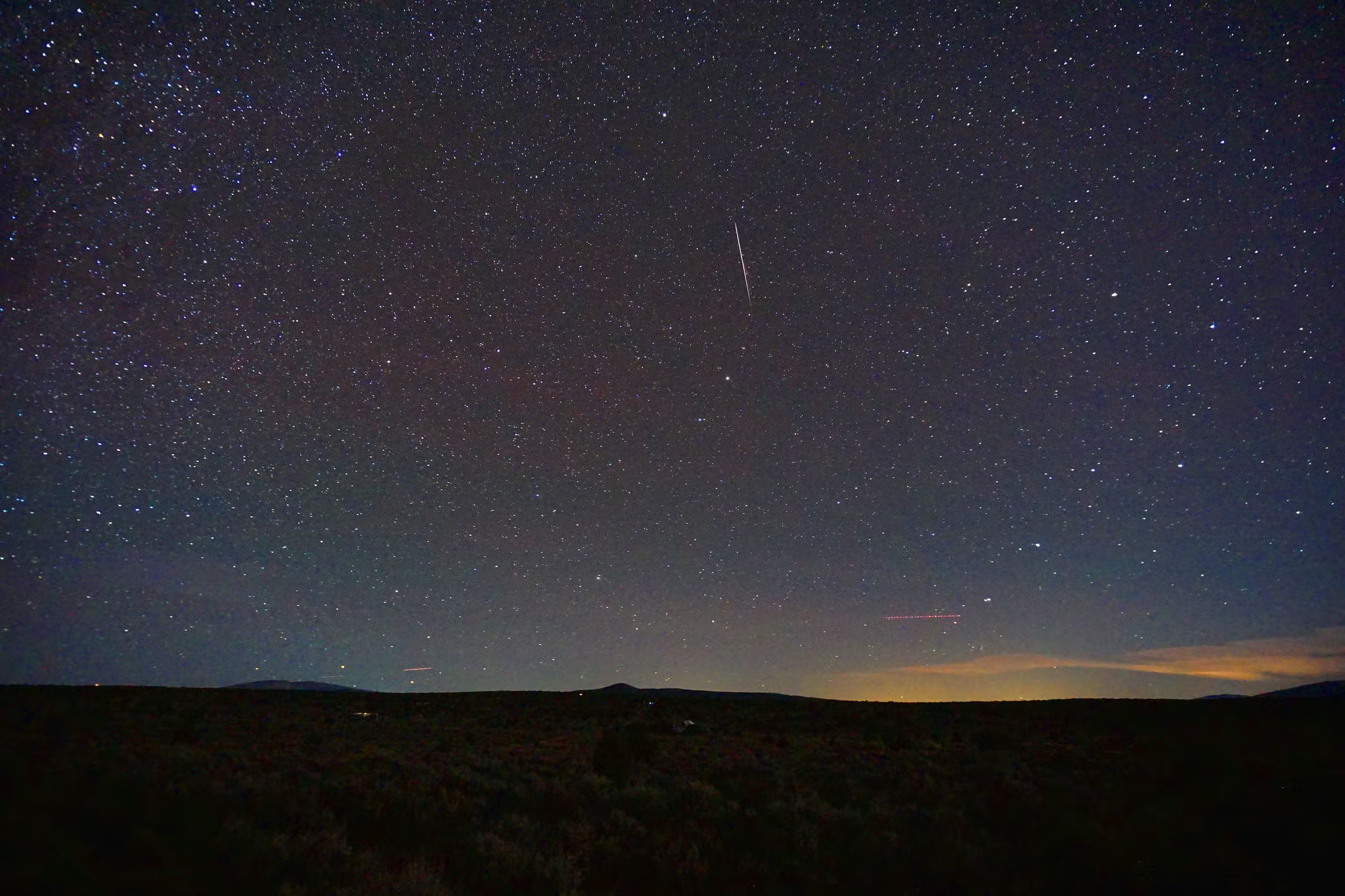
The Draconid meteor shower will be putting on a show for stargazers Thursday evening.
The Draconids occur annually, peaking in October. The meteors appear to be flying out of the head of the Draco the Dragon constellation — which is how they got their name. Chad Jocius, managing director of the Heide Observatory in Kenosha, said stargazers can still make their bedtimes while watching this meteor shower.
“Unlike many of the meteor showers, the Draconids are best viewed in the evening rather than hours before dawn,” Jocius said. “The constellation is pretty high up, so we can start seeing them as soon as it gets dark out.”
The Draconids are expected to peak around 8 p.m. on Oct. 8, but will continue to pelt the atmosphere through Oct. 10. Jocious said Heide Observatory will host a viewing event Oct. 9.
Telescopes and binoculars won’t be necessary for this celestial event and are actually discouraged because they narrow vision of the sky. Thomas Beatty, assistant professor of astronomy at the University of Wisconsin-Madison, said the best viewing equipment is likely in your garage.
“I would suggest for people who are interested in viewing it, really the best equipment here is a lawn chair or a camp chair, a coat, and a little bit of patience,” Beatty said.
The best conditions for meteor shower viewing are dark moons and clear skies. During the peak of the Draconids, the moon will be about 3 percent illuminated creating dark skies optimal for viewing.
Those interested in viewing the shower should go somewhere with little light pollution, and allow about 20 minutes for their eyes to adjust to the darkness.
Although known as a smaller meteor shower, Draconids can be unpredictable. They have had rare outbursts of creating huge meteor storms. NASA said 500 meteors were seen per minute in Europe in 1933.
“The last couple of years, it has not been that big,” Beatty said. “I think this year we’re expecting probably something like five to six meteors per hour. So not huge, but definitely a handful.”
The meteors are made up of debris left behind from the comet Giacobini–Zinner. The comet takes about 6.6 years to orbit the sun and leaves a trail of particles as it flies. The debris burns into the atmosphere as the Earth moves through the trail, creating the meteor shower.
“What collides with the Earth and causes these meteors are probably much smaller than what you’d expect,” Beatty said. “Something as small as a grain of sand can cause one of the streaks you see in the sky as a meteor, and the reason for that is most of these grains of sand are hitting our atmosphere at a tremendous velocity.”
Draconids arrive at slower speeds compared to other meteor showers — some hit the atmosphere at 160,000 mph. That being said, they still collide with Earth at around 46,000 mph.
Beatty said astronomers speculate the Draconids could be pulled off the course of Earth’s orbit — which is another reason to look up. The Giacobini-Zinner comet is expected to pass close to Jupiter which could cause it to deflect.
“We don’t actually know exactly how that’s going to affect it,” he said. “If Jupiter pulls it with its gravity and moves it onto a new orbit, it may actually end the Draconid meteor showers in about three or four years.”
Besides its potential departure from Earth’s view, Beatty said the Draconids will provide stargazers with a sight worth seeing.
“One of the lovely things about meteor showers like this is that you can actually see the Earth interacting with the rest of the solar system,” Beatty said. “It’s pretty amazing that for a moment we get to see these tiny pieces of comets making themselves known to us.”
Wisconsin Public Radio, © Copyright 2026, Board of Regents of the University of Wisconsin System and Wisconsin Educational Communications Board.