


Wisconsin News
‘We’ve seen this before’: Bird flu again hits Wisconsin poultry farms
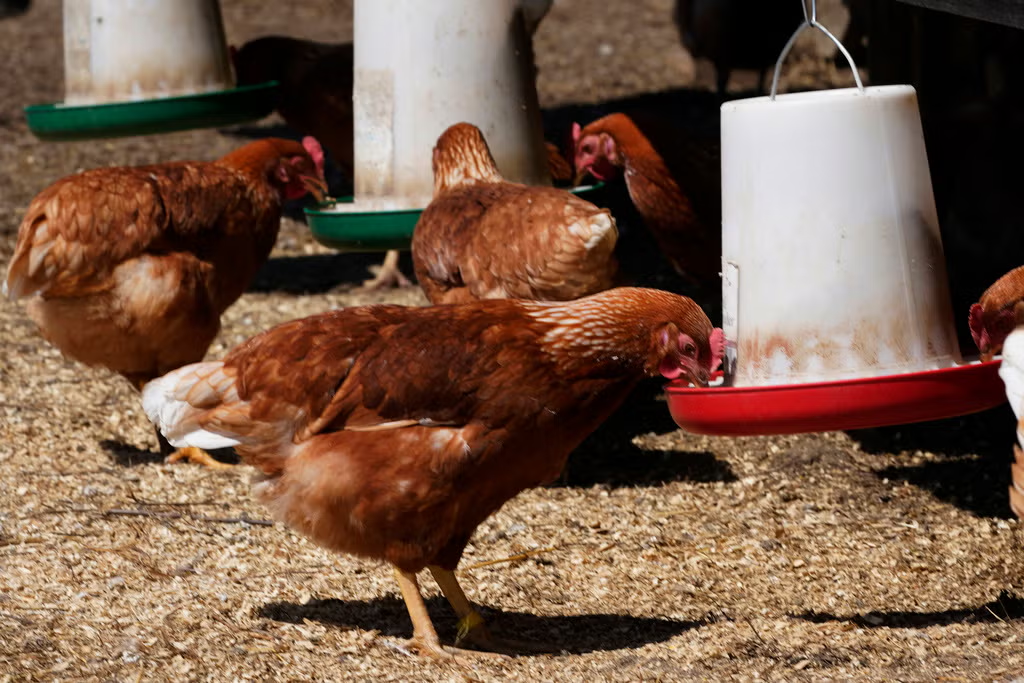
Two large-scale commercial poultry farms in southeastern Wisconsin have been hit with avian flu, each with roughly 1.5 million birds that will be culled.
On Friday, the Wisconsin Department of Agriculture, Trade and Consumer Protection, or DATCP, reported the first case of avian influenza in Walworth County since the highly contagious virus started affecting farms in 2022.
The state also reported the disease in Jefferson County. It’s the second commercial poultry farm hit in that county this year, and the fourth confirmed case in the state in just over a week.
“We’ve seen this before, so it’s not entirely new,” said Ron Kean, University of Wisconsin-Madison’s poultry specialist, about the size of the latest confirmed cases. “But it’s a pretty large percentage of our egg production in the state, so I think from that aspect it’s noteworthy.”
Avian flu outbreaks have been one of the drivers of past record-high egg prices for American consumers.
Kean said the rapid-fire cases so far don’t necessarily indicate a more active season of avian flu this spring.
The virus has continued to circulate in wild birds since 2022, leading to sporadic outbreaks at farms in Wisconsin and across the country. Kean said that’s likely to continue this year, but state officials will also be looking for possible links between the three cases.
DATCP declined WPR’s request for an interview Friday on the latest outbreaks.
In Jefferson County, which has had a total of six avian flu cases in the last four years, one of the farms that is currently responding to an outbreak was also hit by the virus in 2025, according to county health director Elizabeth McGeary.
She said responding to the outbreak last year and overseeing the safe culling and disposal of infected birds put a strain on county and local resources. It also impacted nearby residents and created potential public health and environmental concerns.
“The response scale was huge,” McGeary said. “There were millions of birds. There were a lot of different transport volumes and issues. The composting footprint was really enormous, and it required substantial local government time and coordination.”
McGeary and the Jefferson County Board of Health recently sent a letter to state lawmakers asking for regulatory changes and additional resources for avian flu response, calling for the state to move toward a more unified response to the repeated outbreaks.
She said county leaders especially want to see better groundwater monitoring around the sites where bodies of culled infected birds are being composted.
“Rural communities rely on private wells, and this large-scale composting and disposal really increases our population to potentially be at risk for contaminated water,” said McGeary, adding that requiring farms to identify possible compost locations before an outbreak could also help protect public health.
Kean said poultry producers are also growing frustrated by a lack of solutions in this new era of avian flu response.
“There’s going to have to be more work on vaccination, which is a big international political issue,” he said. “That I think is one of the big frustrations for the poultry industry.”
International trade restrictions on vaccinated poultry have made the federal government and some American poultry producers hesitant about a vaccine rollout. But some countries, including France and Britain, are moving toward vaccinating birds against the disease.
Wisconsin Public Radio, © Copyright 2026, Board of Regents of the University of Wisconsin System and Wisconsin Educational Communications Board.